From “Just Asking” to “Architecting Intelligence”: Why Context Engineering is Your New Superpower
We’ve all started here. You open up your favorite AI chatbot, type in a quick question, and get a response that’s… fine. It’s generic, maybe a little surface-level, and definitely not the “aha!” moment you were hoping for.
If you feel like you’re stuck in a loop of mediocre AI outputs, you aren’t alone. Most users are still treating AI like a search engine—a simple input-output machine. But the real power of AI in 2026 isn’t in the asking; it’s in the architecting.
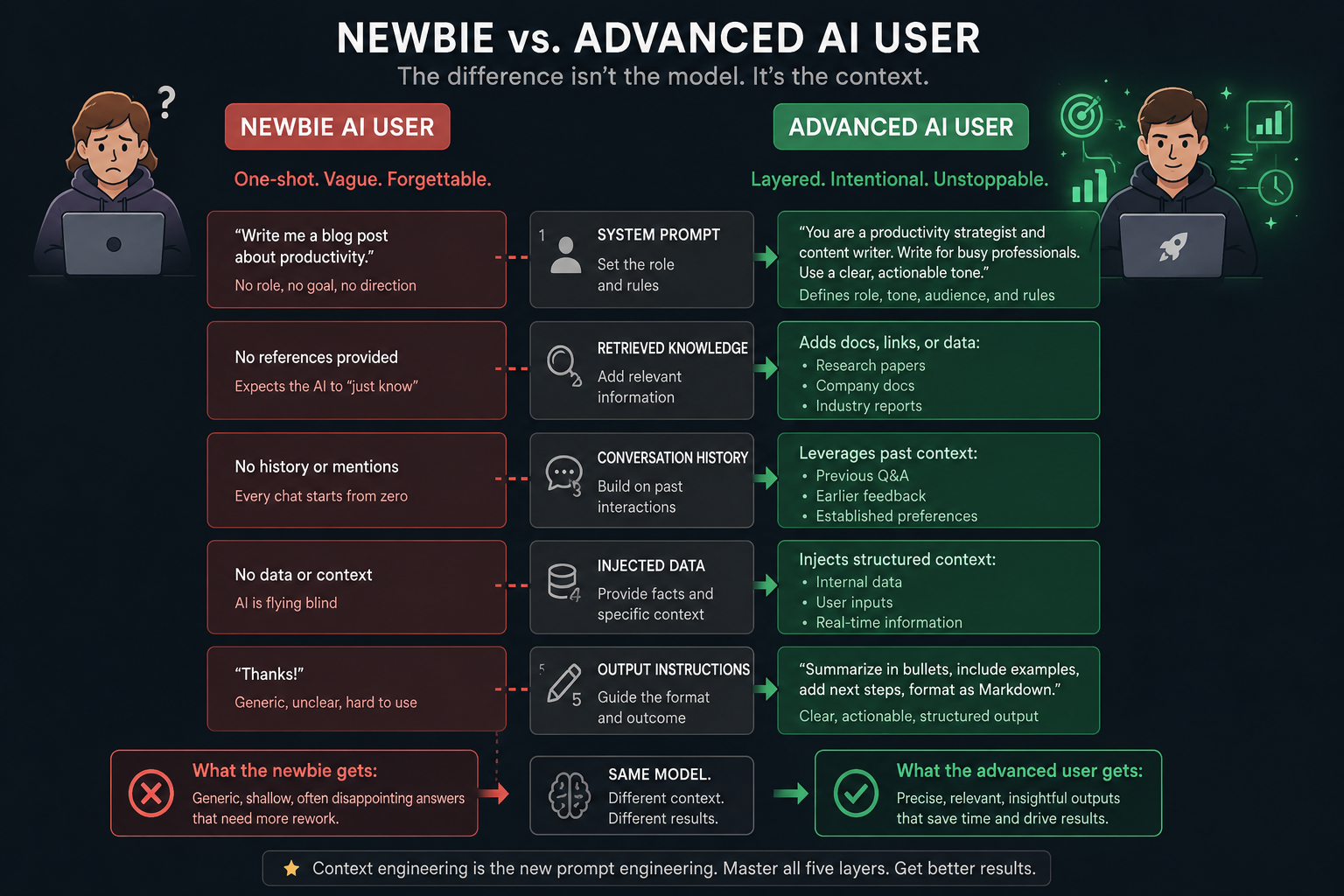
As the graphic above illustrates, there is a massive chasm between “Newbie” usage and “Advanced” usage. The bridge across that chasm? Context Engineering.
The Newbie Trap: Prompting in a Vacuum
When you treat an LLM as a standalone oracle, you’re forcing it to rely solely on its static training data. You’re asking it to guess what you need based on a few words.
This is the “Newbie” approach. It’s fast, but it’s brittle. You get hallucinations, outdated information, and generic advice because the model has no idea who you are, what your specific constraints are, or what authoritative data it should be referencing.
The Advanced Shift: Designing the Environment
Advanced AI usage isn’t just about crafting the perfect prompt—it’s about Context Engineering.
Context Engineering is the art of designing the entire information environment around the model. Instead of just asking a question, you are building a system that feeds the AI exactly what it needs to succeed.
Think of it like this:
- Prompt Engineering is asking the right question.
- Context Engineering is providing the right world for the AI to answer in.
How Context Engineering Transforms Results
When you move to an advanced workflow, you stop relying on the model’s “memory” and start providing the “source of truth.” Here is how you do it:
- RAG (Retrieval-Augmented Generation): Instead of asking the AI to recall facts, you connect it to your own internal knowledge base—your documents, your product specs, your real-time data. The AI retrieves the relevant information before it generates a response, grounding its output in reality.
- Tool Integration (MCP): You give the AI “hands.” By using standards like the Model Context Protocol (MCP), you allow the AI to interact with external services, databases, and tools, turning it from a chatbot into an agent that can actually do things.
- Strategic Prioritization: You learn how to structure your context window. You decide what information is critical, what is background, and how to summarize it so the model focuses on what matters most.
Why This Matters for Your Career
If you take one thing away from this, let it be this: The quality of an LLM’s output is directly tied to the quality of the context you give it.
Two people can use the exact same model, but the one who masters Context Engineering will get results that are 10x more accurate, relevant, and actionable. In 2026, this is the skill that separates the casual users from the AI architects that companies are desperate to hire.
Stop just “prompting.” Start architecting. Your results—and your productivity—will never be the same.