Congruence is the Secret to a High-Performance Life
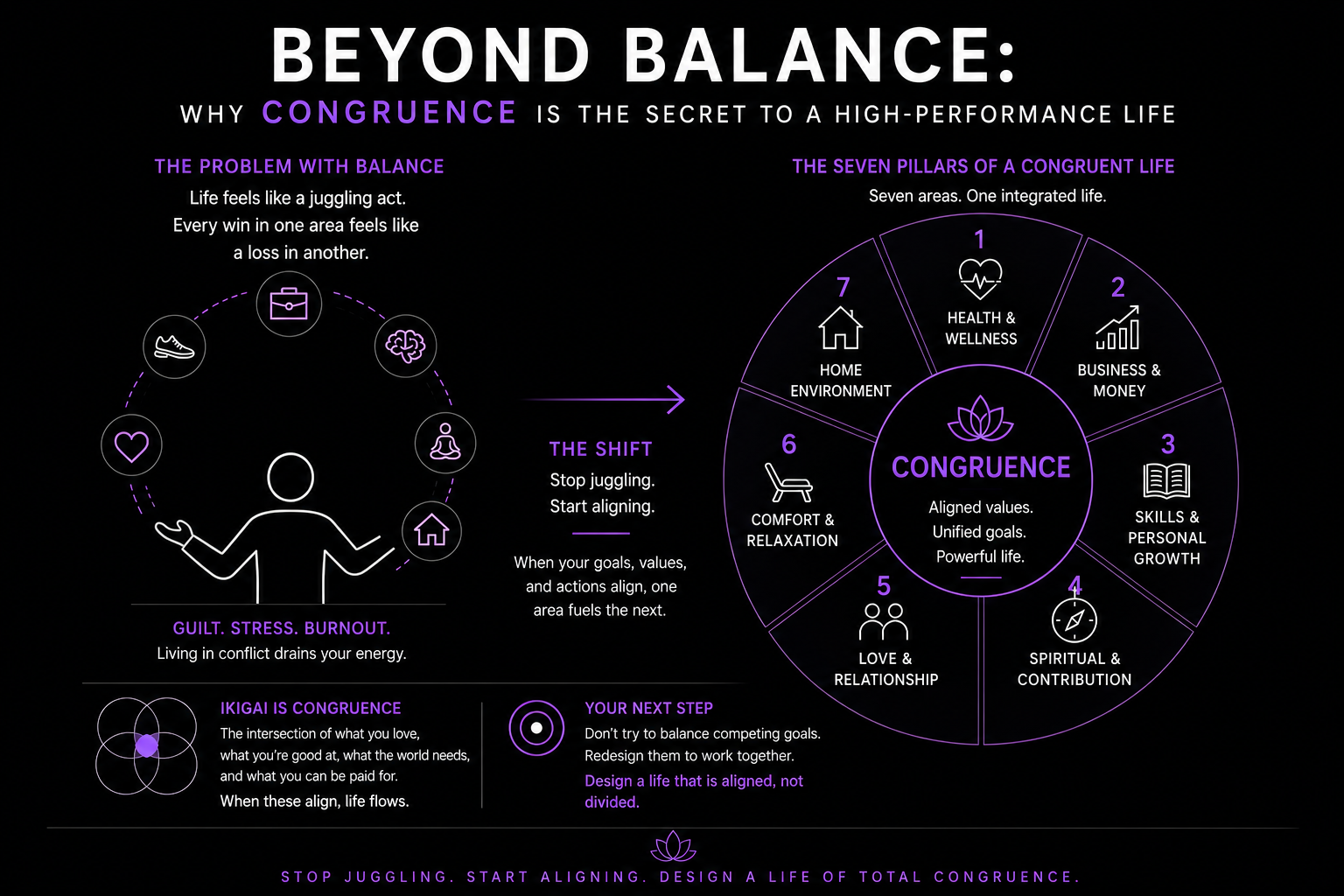
We’ve all heard the advice: “You need to find more balance.”
It’s the mantra of the modern professional. We are told to carve out neat little boxes for our work, our health, our relationships, and our downtime, constantly shifting our energy back and forth like a scale trying to find equilibrium. But there is a fundamental flaw in the pursuit of “balance.”
The very word implies that these areas of your life are in competition. It suggests that if you succeed in business, you must be sacrificing your health. If you invest deeply in your relationships, you must be losing ground in your personal growth. By chasing balance, we are essentially managing a conflict.
It’s time to stop balancing and start designing for congruence.
The Conflict of Balance
When you view your life as a series of competing interests, you create internal friction. You spend your day at the office feeling guilty that you aren’t at the gym, and you spend your evening at the gym feeling stressed about the emails piling up in your inbox. This is a recipe for burnout, not success.
Congruence, on the other hand, is the state where your goals, values, and actions across all areas of life align perfectly. When your life is congruent, your business goals don’t fight your health goals; they fuel them. Your spiritual growth doesn’t take time away from your relationships; it deepens them.
A Congruent Life
To build a life that feels less like a juggling act and more like a symphony, you must design your pillars to support one another. Here are the seven areas I chose to form the framework of a high-performance, low-stress life:
- Health & Wellness: The foundation. If your body isn’t optimized, your business and relationships will suffer.
- Business & Money: The engine. It should provide the resources to support your lifestyle and the freedom to pursue your purpose.
- Skills & Personal Growth: The upgrade. Constant learning should make you more effective in every other pillar.
- Spiritual & Contribution: The compass. This provides the “why” behind your actions, ensuring your success has meaning.
- Love & Relationship: The support system. Your closest connections should be your greatest source of energy and stability.
- Comfort & Relaxation: The recharge. True rest is not an escape from your life; it is a necessary component of your performance.
- Home Environment: The sanctuary. Your physical space should be designed to facilitate the habits you want to build.
These are my personal pillars. You can and should design your own.
Designing for Synergy
The Japanese concept of Ikigai—finding the intersection of what you love, what you are good at, what the world needs, and what you can be paid for—is a perfect example of congruence. When you find that intersection, you don’t need to “balance” your life because your life is no longer a collection of disparate parts. It is a unified whole.
How do you start? Look at your current goals. Ask yourself: Does my business goal require me to sacrifice my health? Does my desire for wealth conflict with my need for spiritual contribution?
If the answer is yes, don’t try to balance them. Redesign them.
Find the path where your business success requires you to be healthy, where your wealth enables your contribution, and where your personal growth strengthens your relationships. When you stop trying to balance your life and start designing it for total congruence, you don’t just increase your rate of success—you reclaim your peace of mind.
Stop juggling. Start aligning.
Key Takeaway
Remember
If your life is congruent, every action improves and reinforces other areas of your life. If you are striking a balance, every action moves a part of your life forward while another part is neglected or retreats.