We’ve entered a remarkable era where the boundary between having an idea and building it has essentially vanished. Despite my professional background in accounting and finance rather than computer science, I’ve managed to transition from simple web publishing to mastering “vibe coding”—a high-leverage way to build autonomous agents and custom apps. My daily workflow now includes CLI proficiency and deep IDE configuration, proving that you don’t need a formal programming degree to orchestrate complex technical environments. It’s truly empowering to realize that with AI, your strategic intuition is the most important tool you have. I hope this encourages anyone sitting on a “cool idea” to dive in; we’re living in a time where technical hurdles are no longer a barrier to creativity.
Completed
My First App - This was the first “vibe code” project I tried on Google AI Studio using their IDE. Just a simple application of 3 main decision making frameworks to answer the user’s question. Not rocket science. But the whole point was to learn how to go through the app development process in the IDE, as well as using GitHub and Vercel to publish the app in my own domain. The project itself is pretty rudimentary, but it’s amazing how much you can learn just by diving in and getting it out there.
Quartz 4 - This website is built entirely on Quartz version 4. It already links to my Obsidian file (which I use every day), so it becomes extremely easy for me to update my live website whenever I have time. Installation is not easy; it requires use of the terminal and a lot of editing of system files using Visual Studio. But once the pipes are connected, it’s a joy to use. It’s like having a direct link from my mind to the world. Because I use Obsidian daily anyway, I can add anything I want the world to see by just writing it in Obsidian.
Telegram to Obsidian Tunnel - Successfully created a private tunnel from Telegram Bot to Obsidian.Deployment involves
- Using Tailscale to create the private tunnel
- Using the REST API in Obsidian
- Connecting to the Telegram Bot via Vercel using a custom Python script.
Obsidian Multi-device Sync via Syncthing - By deploying Syncthing as a decentralized peer-to-peer mesh, you create an encrypted, local-first network that instantly synchronizes your Obsidian vault across nodes using cryptographic device handshakes and file-change watchers while bypassing the cloud entirely.
Currently Working On:
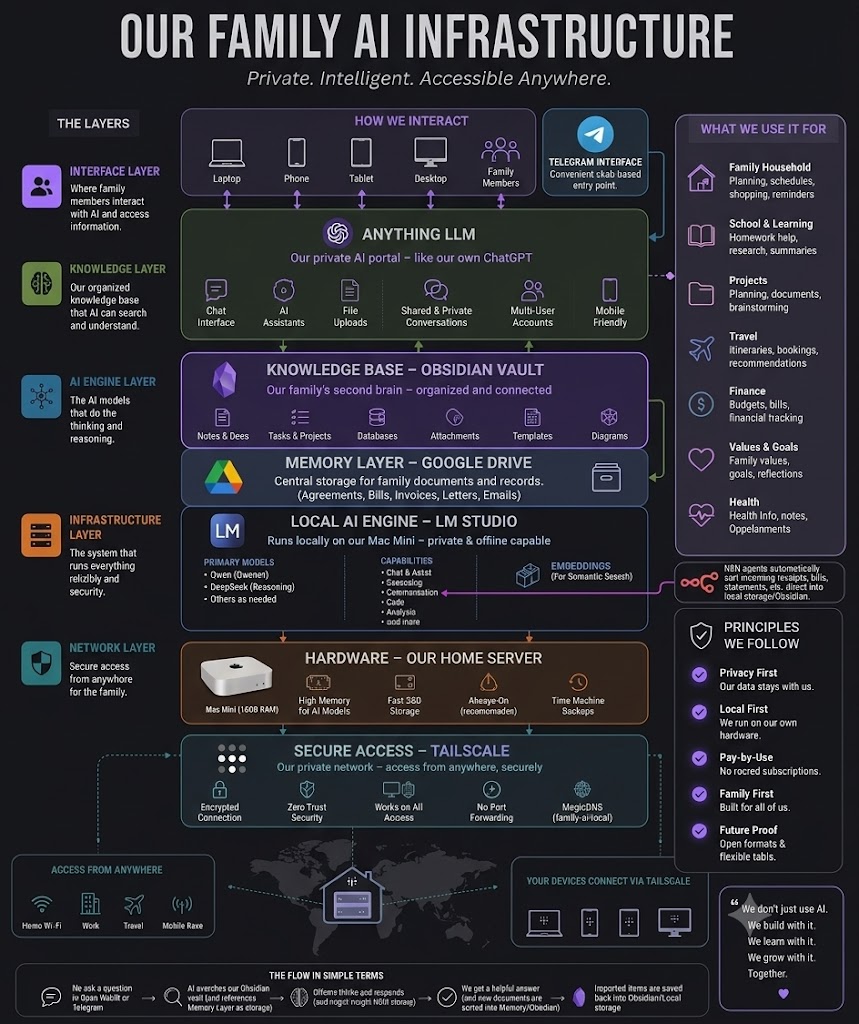
Local Sovereign LLM Project: I’m currently working on the project to host a frontier-level LLM on my own local server. The project is presently delayed as there is a 6-8 week wait for a custom-spec Apple Mac Mini with 64GB of RAM! This is due to the global shortage in SDRAM. In any case, the idea is to build a frontier-level LLM locally. and to make that accessible through my phone, laptop, and tablet from anywhere in the world. Stay tuned for updates on this exciting project.
➡️ Next: My AI Tools